

WHO IS THIS OLD GUY?
“I look in the mirror,” said my late father, the writer Maurice Zolotow --- he with the one or two swoofs of white hair on his otherwise bald head, he with the giant bags under his pale blue eyes, which glinted with curiosity and intelligence, he with his pants hiked up and belted above his spherical pot belly almost to the collarbone just below his multiple chins. “I look in the mirror, “ he said, “and I think, ‘ Who is this old guy?’ “

Maurice and I, in the lobby of Dairy Hollow House, the inn & restaurant I once owned, with my late husband, Ned
I thought this was hilarious and enchanting at the time, which would have been in late 1980’s. When he was about 75 and I about 39.
The reason I thought this was so funny was because, of course, he so clearly was an old guy.
Or he was an old guy to me. As well as objectively.
I was young enough myself that I did not yet understand the truth stated marvelously by Pat Conroy: that the swiftness of “the quicksilvery racehorse passage of time” catches all of us “with the same ineffable start that comes to every man and woman who lives long enough...” And that this “comes as the single great surprise of any life.”
Get old enough, and you too will probably have a similar shock of disbelief.
I do, now that I am, as of this writing, 73.
Last year, I finally stopped coloring my hair, which turned out to be silvery white underneath. I am doubly surprised every time I look in the mirror.
Not only because I see a white-haired woman (who is this old gal?) but that I actually prefer the way it looks to my many years of being a redhead (”It matches my karma,” I used to say, of my auburn decades. Witty, but perhaps no more true than my titian hair, which was courtesy of L’Oreal’s Ginger Twist).
INTRIGUED WITH AGE
I have always been intrigued with age. I ‘m not sure why, but most of my friends have always been older than me, ten, twenty, thirty, forty years older than me. My parents were nearly 40 when they had me -- not all that unusual now, but back in the ‘50’s, very much so. My only sibling was eight years older. Perhaps I simply got used to hanging around with those who were older than I was.
As a child, Helen Kay, an old lady known to me as Miss Kay befriended me, and I her. She lived around the corner from the home where I grew up, in Hastings-on-Hudson, New York. A long-retired home economics teacher from New York’s Ethical Culture Fieldston School, she was the first person to cook and bake with me, and also the first person I knew who had a garden where you grew things you could actually eat (fresh raspberries! fresh corn on the cob, the water for which you brought to a boil before you picked it!). I cook, bake, and garden to this day. Thank you, Miss Kay.
My first marriage, at 16, was to an older man of twenty-eight (which does not seem old at all to me now).
Later, through a process of mutual and delighted adoption, I became friends with the WPA era artist Louis Freund and his wife Elsie, a jeweler and painter. This was in the tiny Ozark Mountain town of Eureka Springs, Arkansas, to which I moved about a month after I turned 18. Louis and Elsie had no children of their own, and I was one of what they called their godchildren.
Whenever I wondered “What the hell am I, a native New Yorker, doing here in Eureka Springs, trying to be a writer and a social justice activist?” I would wander over to their home. This was in a former mattress factory they had turned into the perfect cozy home-and-studio nest for themselves. I’d hang out with the Freunds, and leave their home feeling fundamentally affirmed in the path I had chosen or happened on.
When the two of them moved from Eureka Springs to an assisted living place in Little Rock, in their late eighties, Elsie caught me crying as I helped them pack up their Eureka home for their relocation. How could Louis and Elsie, who had hiked and traveled the world and sketched at the Casbah, at Machu Pichu, Haiti, Cuba, and all over the Ozarks, be reduced (as I saw it) to living in an ordinary assisted living facility? And what would I do without them?
Elsie, seeing my tears, grabbed me firmly by the upper arm, and told me, fiercely, “Crescent... stay fluid.”
If there is better advice about anything, I don’t know what it is.
ELSIE, MISS FERN AND L.P. HARTLEY
Later, when I went to visit the Freunds at Parkway Village, I was astonished to discover that, despite the pleasant but conservatively predictable look and flavor of their well-run assisted living facility, the minute I walked into their home, a duplex, it had exactly the same vibe as their home in Eureka which had solaced me so many times.
The Freunds’ curiosity, their ongoing sense of interest and discovery (the large fern Elsie called “Miss Fern” and misted regularly; a green lizard that came and went from their kitchen windowsill and which they closely and affectionately observed) remained identical to what I had long loved about visiting them in the former mattress factory.
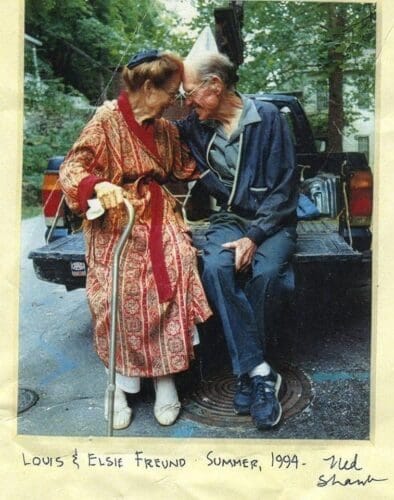
Ned, my late husband, took this of Louis and Elsie during the great “help-the-Freunds-pack-up-and -move” boogie. You can see why I loved them so.
And now I am there, or getting there.
“There” meaning... old.
There aren’t all that many elders left to me to learn from anymore, by which I mean people who are older than me, to whom I may look up, who in some way seem to me to be carrying lanterns to illuminate the path ahead. Most of them have died. And I am in the process of taking my place on the mysterious great mandala which is human life, at least for those of us who are fortunate enough to reach old age. What? You mean now I have to be one of the lantern-carriers for some people who are younger than me?
It’s not always easy to figure out what to do with this, which is why curiosity (rather than judgement or freak-out) is so essential in going through this project somewhat happily. (As the saying goes, “Old age is not for sissies.”)
For instance: I, a writer, can no longer count on finding the word I want the instant I want it. Proper nouns are particularly, irritatingly evasive these days.
Yes, if I chill and just go on doing what I’m doing, eventually the AWOL word or name or phrase will usually pop up, but that requires that I let go of the annoyance at an ability I always had, which I counted on but never even thought about or noticed.
While L.P. Hartley said, famously, in his novella THE GO-BETWEEN,”The past is another country; they do things differently there,” I think it is the future that is a different country.
And the future, for those of us who reach it, is old age.
Where things are done and perceived very differently than in that long busy dream which is middle age, in which most of us spend the majority of our lifetimes.
Until suddenly we don’t.
Suddenly we are in the realm of elderhood.
They do things differently here. And “they” are us.
I KNOW WHY THE AGED BIRD SINGS
As I navigate this change, I find that although it is at times annoying and scary (especially when waking up in the middle of the night with what I call “the weasels of dread” nipping at your throat, or having one of the bouts of ill-health that seem to inevitably come and go with greater frequency as the body ages, no matter how good your self-care is).
BUT.
I also find this new phase surprising and interesting in part because it is so different, and new to me. And there are moments that leave me overwhelmed with gratitude that I got to see or experience something... the Oracle of Delphi, for instance, when I was 72 and much to my surprise, on my first trip to Greece.
But it’s not only exotic, foreign wonders. The pink honeysuckle, in front of a house around the corners and down the street from me, glimpsed in the morning light as I take my daily walk, recently this filled me with a wonder so sharp my eyes filled.
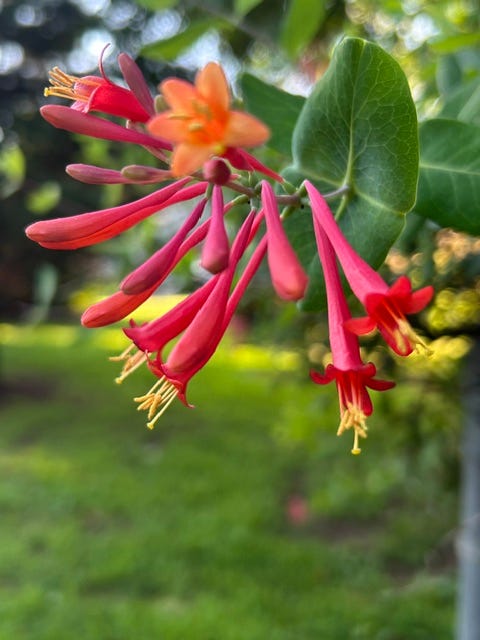
That pink honeysuckle. What business did it have making me fall in love with the world all over again?
It’s like my old friend Bill Haymes once told me. He said he was looking out into his Nashville backyard where he saw two deer, a mother and faun. And as he watched them, he said, “I caught myself thinking, ‘I sure will miss this when I’m gone.’”
Indeed.
Finding interest, surprise and wonder, having and co-creating interesting conversations, sights or experiences that fill us with gratitude as we grow older, even eavesdropping on one’s own thoughts like Bill did --- of course this is a good thing.
Since unless one dies young and until one dies period, aging is inevitable.
And, if one fails to find moments and insights of delight, it would be easy to find elderhood the buzz-killer of all buzz-killers.
Because, no kidding, it is also a phase of one loss after another.
A parade of losses. But to find those moments of delight while watching this parade takes intentionality. Takes making a conscious choice.
Takes strategies, strength, and the willingness to tell ourselves different stories.
STRATEGIES, STRENGTH, STORY
I find myself developing strategies --- compensatory habits to make up for my now-imperfect memory (noticing consciously where I park the car when at the farmer’s market; what shops and buildings I see facing me and the Subaru as I get out; sometimes even taking a picture of where I parked with my phone, so I won’t be wandering around annoyed post-marketing, when loaded down with leeks and strawberries and lilies).
I’ve also done things like strategically adjusted fitness practices over and over (no more loud-music hour-long gym workouts or rigorous yoga classes; instead, shorter sessions, often throughout the day, designed to support balance and equilibrium, prevent falls, fight off osteoporosis and keep flexibility).
Developing habitual actions is also such so helpful: for instance, lay out medications or supplements in the same place, at about the same time, so you know if you took ‘em or not. (Yes, you can set your phone as a reminder until it becomes a habit That’s a strategy! Simple though it is). And yes, leave the car keys and phone in the exact same place every single time (something I was seemingly incapable of doing when young,
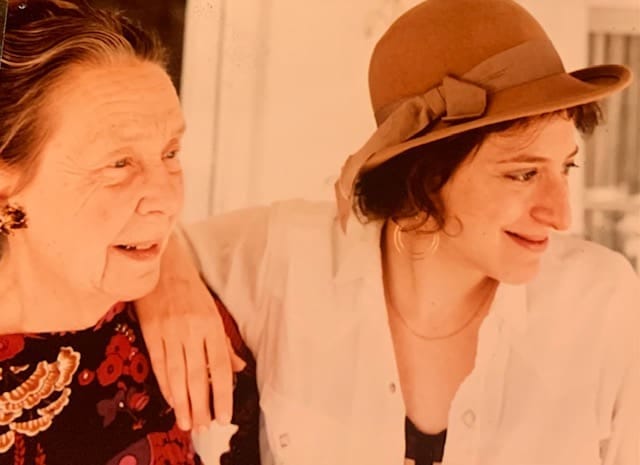
Virginia and me: was I ever that young? And now I’m almost the age she was! This blows my puny little mind.
Another essential piece if I am to age wisely: finding strength. Physical and psychological. Both seem to me essential, and, as with the strategies, both take conscious, intentional work.
As the abilities of my body change despite my best efforts, and as I lose friend after friend (to moving across country to live with their adult children; to dementia, to cancer, to stroke, to death), I work hard and consistently to maintain what I have and maybe, just maybe, develop in new ways. Except when I don’t, or, on a given day, can’t. But this makes me miserable, and so I go back to strength-seeking activities and perspective.
I still lift weights, and if they are a little lighter than I used to lift, I remember what my GP, nurse practitioner Myrrh Hector, told me when I complained about this: “Never compete,” she said, she said, “with who you used to be.” This was helpful, and I return to this idea often in thought.
As for psychological strength, that is more challenging. But age has a helpful reminder for me: I remember all the hard things I went through in the past, like being in the family room at the hospital and having the ER doctor come in and say, of Ned, the man who was the great love of the first half of my life, and who had been out bicycling until he and a pick-up collided --- “We lost him.” Will anything else be as hard?
And yet, as Elaine Stritch sang, though perhaps not quite so world-wearily, “I’m still here.”
Sometimes I think the essential trick is just getting up one more time than you fall, or are pushed, down. In this, I find that the stories I tell myself about this new phase make a huge difference.
For instance, another one of my older friends, the late Virginia Carey, --- we were friends when I was in my late teens and early twenties, and she was in her mid-seventies - had extremely disrupted sleep.
I developed a story about this, not realizing I was doing so. See, for my sleep patterns had always been idiosyncratic and troublesome. When, in my 30’s and 40’s, I’d wake up in the middle of the night, anxious and wired. I would tell myself something like, “And you know it’s just going to get worse, Crescent. It’ll be just like Virginia.”
As you can imagine, this did not exactly quell anxiety.
Well! Imagine my surprise when, starting in my late 60’s, I began to sleep far better than I ever had. I fall asleep quickly now, which never happened when I was younger. This astonishes me to this day!
And, aforementioned weasels not withstanding, I rarely find myself wide-awake and unable to return to sleep in the middle of the night. But all those years I suffered from worry about my sleep being likely to get even worse as I hit elderhood!
That, it turns out, was a mere story I told myself. A story that was untrue and didn’t serve me. Hence the subtitle of my upcoming “mistressmind” group, I Know Why the Aged Bird Sings: Strategies, Strength and Story for Aging Visionaries.
WHAT’S A MISTRESSMIND?
Perhaps you’ve heard of “mastermind” groups?
Small, peer-to-peer mentoring and co-brainstorming cohorts, Masterminds are built around a shared, common set of challenges or life-circumstances, and usually led or facilitated by a professional coach or teacher. The “common set” unifying any given mastermind group could be anything: organic gardeners in the South, ham radio operators, breast cancer survivors, parents of trans children, parrot-owners, cooking school teachers.
Masterminds typically take place over a set period of time, usually three months to a year. They offer ongoing curated, focused networking, wisdom and support among peers. Participants have access to the ideas of both the individuals in the group’s knowledge and that of the facilitator. And sometimes things surface from the collective, as discussion bounces around within a loosely structured curriculum.
With a regular time and place to meet, Masterminds are a safe place in which to look the weasels of dread out loud, as well as the hopes and surprises, of whatever circumstances are the common focus of the group. And, as the individuals in the group gradually get to know and trust each other... sometimes the near-miraculous unfolds.
Those in the group share experiences, think out loud, explore fears, longings, and hopes, solve problems and generate ideas. Mastermind partners both support and hold each other accountable for self-articulated personal or professional goals.
The results, in such a group, when well-run, are powerful.
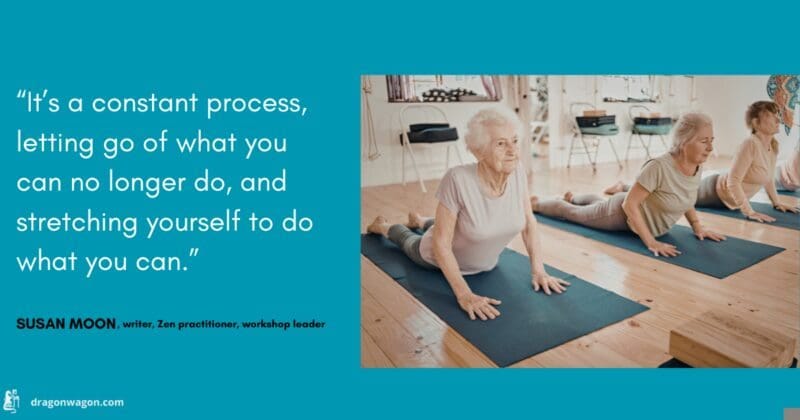
“It’s a constant process, letting go of what you can no longer do, “ noted the writer and Zen practitioner Susan Moon, in her book THIS IS GETTING OLD, one of two she wrote exploring the topic, “and stretching yourself to do what you can.”
This stretch is easier and more insight-rich when one doesn’t try to go it alone.
I am leading a mastermind this summer and early fall, called I Know Why the Aged Bird Sings. But because it is for women only (women over 60 though I’ve let a couple in their late 50’s slide in), I am calling it a mistressmind.
So there.
WHAT WE’LL WORK WITH
We certainly share a common set of challenges or life-circumstances. Here are a few of them:
Our changing physical selves: health, energy levels, balance, sexuality, flexibility, the amount of pain or dysfunction we may find ourselves living with; medications, pro and con and side effects
Our changing looks: what we see when we look in the mirror, how the world treats us because of the way we look, whether or not we are out of or in the game of seeking a partner
Our changing social selves: children grow up and may move away, friends die or develop dementia, we may suddenly find ourselves “invisible” or condescended to as we walk through life; we may try co-housing
Our changing roles: we may find ourselves caregiving our partners or parents; we may find ourselves widowed; we may face mandatory retirement; there may be family estrangement or unexpected grandchild-raising
Our changing minds: where did I put that name or proper noun? What did I come upstairs for, again?
Our changing sexuality: perhaps we still want it, but our partner doesn’t, perhaps the reverse; perhaps we love not being solo but still hunger to, well, get it on... and then there are questions of hormones, lube, etc
Our new, sometimes limited, lifestyle options: stay in our own homes or move to assisted living or self-created co-housing? Stay in this country, or move abroad? Live on Social Security or continue to (or go back to) work?
Our changing rhythms: we may find ourselves living alone and discover we deeply enjoy solitude... or we may find ourselves lonely; we may take a class and discover we love painting, making pottery, writing, or improv... or don’t!
Our changing feelings: we may get less upset about “the small stuff” than we did when young; we may wake up at 3:00 AM with the weasels biting our throats
Our changing fiscal status: Social Security? IRA draw-downs? I-only-have-enough-to-live-on-if-I-move-to-Mexico-or-in-with-my-kids?
Our new proximity to mortality: how do we work with death, eyes wide open, and yet not morbidly? And what about our wills or trusts and who we leave what to? And to whom so we give health proxy?
Our choices about all these and almost every aspect of life in an aging body: how do we make them? Who can we talk with about them?
These are some of the things we’ll explore in our mistressmind group, I Know Why the Aged Bird Sings, which will meet once a week for two hours in the late afternoon, via Zoom, for fourteen sessions, this July, August, and September. It costs $1900 (payable all at once or over time).
THANKS, MAYA ANGELOU
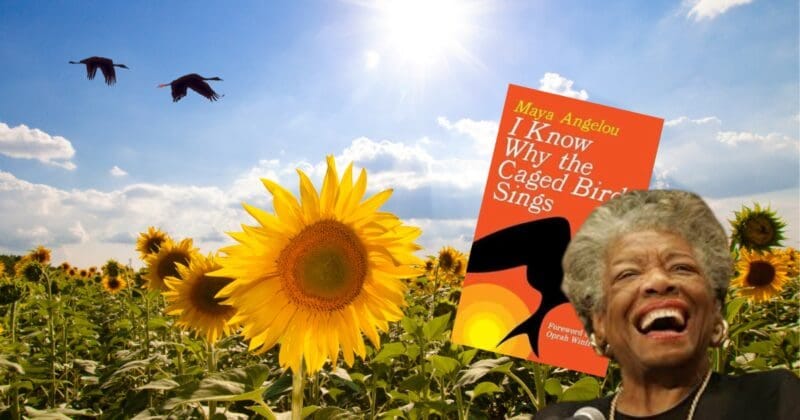
“Aged Bird,” as you may well know, takes off from the poem Caged Bird, by the brilliant poet and writer and thinker, Maya Angelou, a fellow Arkansawyer. Here’s how it begins:
A free bird leaps
on the back of the wind
and floats downstream
till the current ends
and dips his wing
in the orange sun rays
and dares to claim the sky.
But a bird that stalks
down his narrow cage
can seldom see through
his bars of rage
his wings are clipped and
his feet are tied
so he opens his throat to sing.
The caged bird sings
with a fearful trill
of things unknown
but longed for still
and his tune is heard
on the distant hill
for the caged bird
sings of freedom...
It’s hard to argue that in some ways aging cages us.
Less travel. Immobility. Being locked in a “memory-care” facility. Losing one’s partner, one’s friends. Receiving, or having someone you love receive, a harsh, non-negotiable medical diagnosis. Lifelong dog or cat-lovers who decide, regrettably, it’s too late in life for them to adopt a kitten or puppy (either because they feel they can’t take care of it, or they’ll trip over it, or it will outlive them, and then what?). And so they do without animal companionship, while longing for it.
Yet, as we Aged Birds sing longingly of freedom, some of us find it in surprising ways.
There’s the freedom of, at last, not caring about what other people think; in the words of podcaster Mel Robbins, “Let them.” There’s the finding an effortless comfort with oneself and with the process of aging, which so many of those I know remark upon. I too dwell in this at times. What quiet joy and ease it brings, and what a surprise it is!
Most often I hear this summed up as “self-acceptance.” But it’s more vibrantly, dimensionally peaceful than that implies. And somehow, sometimes, mysteriously and miraculously, this acceptance even extends to other people who one once would have found deeply annoying.
“I no longer feel the need to correct every piece of stupidity I hear,” says one friend of mine, who used to do just that (with the results that some other people were infuriated with her, and others filled with admiration).
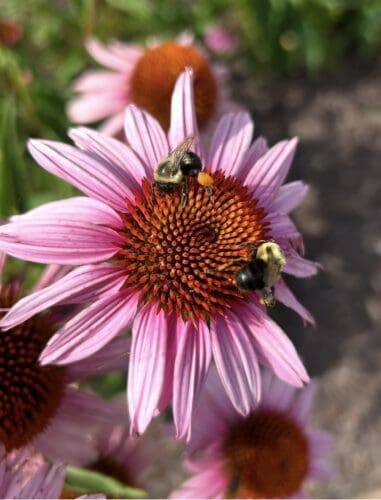
The noticing and appreciating of small beauties, the wonders of the natural world, as mentioned. On my morning walk, I will see an echinacea flower in bloom, or even a weed gone to seed, or raindrops spangling a leaf of my neighbor’s Japanese maple, and the extraordinary loveliness suddenly occasions tears springing to my eyes. The wonder! (And often I get out my phone and take a picture, something I could never get the hang of back when good cameras were complicated mathematical and technical propositions, with F-stops and light meters and such. This too delights me.)
And for many Aging Birds, the sheer transcendent poignant joy of becoming and being a grandparent, and seeing the beginning of the next story, while knowing you will not see its end.
In Aged Birditude, unlike the one Angelou describes, we can sometimes take our crone claws and unlatch the cage.
I invite you to do so, and fly with me and each other, on your beautiful gray-feathered wings. We’ll catch the thermals together, soaring.
Crescent, the Mistressmind group is so enticing! I love the way you write about it and need to consider how the 2-hours-per-week meshes with the life I am keeping full—or at least busy! Thanks for writing so richly. 🙏
Stay fluid: my new North Star 🙏🏼🙏🏼🙏🏼